Why One Simple Photography Exercise Can Quiet Your Overthinking Brain
A Moment of Respite That Helped Me Reset
It’s been a tough year. Some major illnesses, a death in his family, a death in my family, awkward interactions with old acquaintances, a rift in the family, financial struggles, a torn bicep and an intense fall on a trail that left a hip injury that has taken forever to heal. My attention has been stretched to the max while the body has shown definite signs of fatigue. Which only creates more stress. I know I need to remember to live in the now and not stress on lost opportunities or over stress on “what if’s” of the future. But … it’s been a tough year.
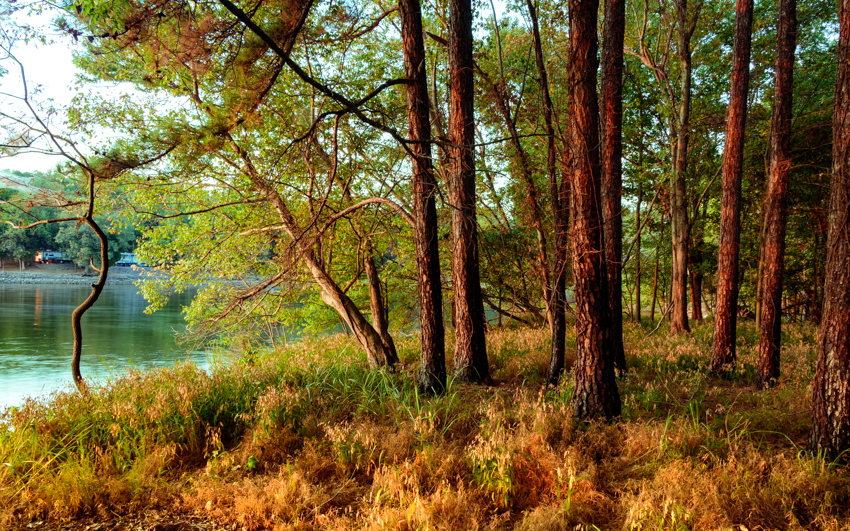
A few months ago, we were in a park by a lake and the RV was parked on a hill overlooking an ordinary stand of trees. In the mornings I would sit outside and watch the light caress the shoreline as the sun rose. The light reflected off the water and made it sparkle. The trees became magical as the sun crept under them and lit up the branches. After sunrise… the trees WERE ordinary, the shoreline unremarkable. Nothing to be inspired by, nothing to stop my attention.
I watched for 3 mornings. Fascinated, but … tired.
Finally, I went.
Light fascinates me. How it reshapes, and colors, and creates a mood… joy or mystery or happiness or gloom. It transforms a forest into a fairy land, alive with imagined fairies, elves or various other “little people”. You can almost see them hiding and playing and winking at you from the underbrush as the sunlight rises with the day. Changing shapes and outlining branches and brush as it moves.
I went and shot and studied and shot some more. I felt peace warm my heart as I concentrated on nothing but the light and the shapes and colors it was creating.
After that first morning hour of glow… nothing.
There was nothing spectacular about it. Nothing anyone else would have noticed. When I showed my partner the images, he asked, “where was that?!”. I pointed down the hill. We don’t always see the same things even when we are having the same experiences in the same area. I have asked the same of him on some shoots.
But that small window of light pulled me into stillness. For that time, I didn’t think about anything else — not my sorrow, not my pain, not my to-do list, not the hundreds of things I had been worrying about.
Just that glow.
That silence.
That simple, generous moment of beauty.
And that’s the moment I remembered:
You don’t find peace by escaping life.
You find it by noticing the life that’s already here.
Sometimes life starts moving so fast that you don’t even realize you’ve been holding your breath.
You rush through the day, ticking boxes, answering messages, doing what needs to be done… and then, out of nowhere, something simple stops you.
A shift in the wind.
A ripple of light on a wall.
The way a leaf trembles before it falls.
And for a moment, you’re reminded that you’re alive.
Photography has always been that pause for me — not the act of taking a picture, but the act of learning, again and again, how to see.
In a world that pushes us to produce and perform, to keep moving forward without really thinking, burying our emotions to do what is “right”, photography gently insists on the opposite.
It asks you to slow down. To pay attention. To notice what’s right in front of you.
It’s not about perfect gear or perfect settings.
It’s about shifting from looking to truly seeing.
Why Photography Slows the Mind
When you lift a camera — or even just imagine lifting one — something changes internally.
Your pace softens.
Your senses sharpen.
Your awareness widens.
There’s a beautiful term for this called “soft fascination.” It’s the kind of attention nature inspires naturally, the effortless noticing that doesn’t drain you but restores you. Instead of forcing concentration, your mind relaxes into curiosity.
Soft fascination is a concept from Attention Restoration Theory (ART) that describes a type of effortless attention triggered by natural environments. Unlike “directed attention,” which requires mental effort and leads to fatigue, soft fascination engages the mind in a relaxed, non-demanding way.
Natural elements — such as flowing water, rustling leaves, singing birds, or shifting light — provide just enough stimulation to keep the mind gently focused while allowing higher cognitive processes to rest and replenish. This restorative effect is why time in nature often improves clarity, reduces stress, and enhances overall mental functioning.
You stop thinking about what’s next and start inhabiting what’s now.
This is why so many people say photography feels like meditation. It’s not the image that heals us. It’s the practice of being present enough to make it.
The Simple Photography Prompt: “One Thing, Fully”
You don’t need a fancy camera for this — your phone is perfect.
This week, try this:
Choose one simple, ordinary thing in your environment
and give it your full, unhurried attention for 2 minutes.
That’s it.
A leaf.
A shadow.
A cup.
A branch.
A line of clouds.
Your partner’s hands.
The steam rising off your coffee.
Study the textures, shapes, movement, light, and color.
If you want, take a single photograph — only one — and let it be whatever it is.
The goal isn’t to make a masterpiece.
The goal is to retrain your eyes — and your heart — to notice what’s been quietly waiting.
A Closing Thought
When you teach yourself to see the world slowly, you begin to move through it more gently.
And in that gentleness, life opens up.
Beauty returns.
Clarity returns.
You return.
Nature doesn’t ask us to try harder.
It simply invites us to pay attention.
And that, more than anything, is the art of seeing.
